

Jul 11, 1991
Aug 1, 2025
Alberta
36 years
Roy Sobotiak
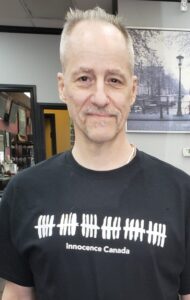
Roy Sobotiak spent 36 years in prison for a murder he did not commit, making him Canada’s longest-serving wrongfully convicted man. Coerced into confessing through a controversial Mr. Big sting operation despite no physical evidence, he maintained his innocence for decades. In 2025, after a review by Innocence Canada and the Minister of Justice, his conviction was quashed and he was finally exonerated.
Legal Materials
In the News
The journey
to justice
February
Roy was one of the last people to see Susan Kaminsky before she went missing.
October
The Mr. Big Sting operation began with an undercover detective befriending Roy.
September 20 - 26
The undercover detective pushed Roy for details about Susan’s disappearance and death. Heavily intoxicated, Roy confessed. Under constant and repeated questioning, his story changed, each time clearly shaped by what the undercover detective told him he had or had not done.
September 27
Roy was charged with first-degree murder in a presumed death.
July 11
After a trial in the Alberta Queen’s Bench Court, Roy was convicted of second-degree murder.
September 9
Roy was sentenced to life in prison with no eligibility for parole for 16.5 years.
July 31
Roy’s appeal to the Alberta Court of Appeal was dismissed.
April 15
Roy’s application for leave to Appeal to the Supreme Court of Canada was dismissed.
February 19
Roy applied for ministerial review.
May 30
Manitoba Court of Appeal quashed Sanderson’s convictions and ordered a new trial
DNA analysis was conducted, and it did not support the false confession Roy made while intoxicated in 1989.
February 26
The Minister of Justice and Attorney General of Canada, quashed Roy’s conviction and ordered a new trial. The Alberta Justice Minister filed a judicial review, arguing that no reasoning was provided for the decision.
May 23
Roy was granted bail.
August 1
The Alberta Crown Prosecution issued their remedy to order a Stay of Roy’s second-degree murder conviction and not proceed to trial.
The Case
Roy Sobotiak was a troubled young man who led a dysfunctional existence. At age 26, he was arrested for the murder of 34-year-old Susan Kaminsky, a single mother of two children, who had babysat Roy when he was a child.
The police focused on Roy immediately when they determined that he was the last person known to be seen with Ms. Kaminsky before she disappeared without a trace. The news of Ms. Kaminsky’s disappearance adversely affected the city of Edmonton, Alberta.
The police had little to no evidence to charge Roy, so they resorted to using a controversial undercover technique known as the Mr. Big Sting Operation. The sole purpose of this tactic is to extract a confession from the target using any means necessary.
Roy was extremely vulnerable and naïve. He was easily manipulated by the police. Roy had battled drug and alcohol addictions most of his life. On one of the wiretaps obtained during the Mr. Big Sting, he is recorded talking about his struggles with addictions which the police used to their advantage.
For nearly a year, an undercover detective posed as a drug dealer, staged fake drug deals, lured Roy into hotel rooms and plied him with alcohol, trying to coax him to confess to Ms. Kaminsky’s disappearance and murder.
On September 20, 1989, after consuming a 26-ounce bottle of vodka given to him by one of the undercover detectives, Roy confessed. He was clear when he admitted that he was highly intoxicated, so much so that he collapsed and fell to the floor during the confession. Over the following days, under constant and repeated questioning, his story changed, each time clearly shaped by what the undercover detective told him he did or did not do.
Despite the fact that there was no body and no forensic evidence linking Roy to Ms. Kaminsky’s disappearance and suspected murder, his coerced confession was the cornerstone of the prosecution’s case.
On July 11, 1991, Roy was convicted of 2nd degree murder for the disappearance and murder of Susan Kaminsky, with no eligibility for parole for 16 years.
In 1994, Roy lost at the Alberta Court of Appeal, and in 2004, the Supreme Court of Canada refused to hear his case.
The Fight for Justice
Roy spent an agonizing and terrifying 36 years behind bars for a murder he did not commit, consistently maintaining and fighting to prove his innocence. Roy is now the longest-serving wrongly convicted man in Canadian history that we know of.
After his conviction and losing his appeals, Roy tirelessly championed his own case. From prison, he wrote a 1000-page handwritten request to the Parole Board of Canada for a pardon. In 2021, he filed a S.696.1 application for Ministerial Review with the Criminal Convictions Review Group (CCRG) and the Minister of Justice.
Recognizing that Innocence Canada had previously reviewed Roy’s case, the CCRG reached out to the organization. As a result, Innocence Canada joined Roy in his fight to clear his name. The case raised serious concerns within the Department of Justice and lead the Minister of Justice, Arif Virani, to quash Roy’s second-degree murder conviction and order a new trial on February 26, 2025.
On May 23, 2025, Innocence Canada successfully attained bail for Roy and then waited for the Alberta Crown’s Office to decide whether they would proceed to a new trial with Roy’s case or advance an alternative solution.
The Exoneration
On August 1, 2025, after more than three decades in prison and two months after his release on bail, the Alberta Crown Prosecution advised Innocence Canada that their remedy was to order a Stay of Roy’s second-degree murder conviction and not proceed to trial. Roy was happy that his long, painful journey through Canada’s criminal justice system had finally reached a conclusion. He also acknowledged through counsel that it would not be easy to adjust to a very different world from what he knew in 1989:
“I was 26 when I went in. I am 61 now. Everything will be different.”
Life After Exoneration
Today, Roy is rebuilding his life and is grateful to have that opportunity and to the people who are assisting him as he navigates through the daily challenges in a free and complicated society.